
The Ultimate MarTech Audit: How to Stop Paying for Software Nobody Remembers Buying
A Martech Architect's complete checklist for evaluating Databricks, Snowflake, BigQuery, and Redshift when paired with a 3rd-party Customer Data Platform.

If you check your department’s credit card statements right now, there is a 94% chance you are paying $299/month for a “next-gen engagement platform” whose sole active user left the company in 2022.
Welcome to modern marketing operations, where the average enterprise stack holds over 15,000 potential software tools on the market, and the average marketing team utilizes dozens of disconnected point solutions, half of which do the exact same thing.
Building a revenue-generating tech stack isn't about collecting tools like Pokémon cards. It’s about thorough architecture, ruthless consolidation, and continuous planning.
Below is access to a guide that helps you understand your current MarTech stack, ending SaaS sprawl, and building an ecosystem that actually drives growth.

1. The Real Cost of "Tool Bloat" (It’s Not Just the Subscription)
When most CMOs look at software costs, they only see line-item invoices. But the hidden tax of an unorganized martech stack is far more expensive than monthly license fees:
- Data Fragmentation: When your CRM, email platform, and product analytics don't sync cleanly, customer data gets trapped in silos. You end up emailing leads who bought your product three days ago.
- Context Switching & Fatigue: Your team spends 20% of their week manually exporting CSVs from Tool A to re-upload into Tool B because nobody set up an API integration.
- Security & Compliance Risk: Forgotten platforms sitting on legacy customer data are a GDPR/CCPA nightmare waiting to happen.
       [ Unmapped SaaS Sprawl ]
                  │
     ┌────────────┼────────────┐
     ▼            ▼            ▼
Data Silos   Dark Costs   Security Gaps
2. The 5-Layer MarTech Architecture Framework
Before you go on a firing spree and cancel every subscription in sight, you need to map your tech stack against functional business layers. A modern, high-performing marketing engine breaks down into five primary layers:
| Stack Layer | Primary Function | Example Categories |
| 1. Data & Identity | Unifies behavioral data into a single source of truth | CDPs (Segment), Data Warehouses (Snowflake), Behavioral Analytics (Amplitude) |
| 2. Systems of Record | Stores core customer, deal, and financial history | CRM (HubSpot, Salesforce), Commerce (Shopify), Billing (Stripe) |
| 3. Lifecycle Engagement | Activates audiences across channels | Marketing Automation, Email/SMS platforms, In-app messaging |
| 4. Acquisition & Ads | Captures interest and drives top-of-funnel conversion | Paid Media Manager, SEO platforms (Ahrefs, Semrush), Landing page builders |
| 5. Governance & Ops | Manages workflows, AI agents, and performance tracking | Attribution tools, iPaaS (Zapier/Make), Project Management |
If a tool in your arsenal doesn't clearly feed into one of these five layers with measurable ROI, it’s a prime candidate for consolidation.
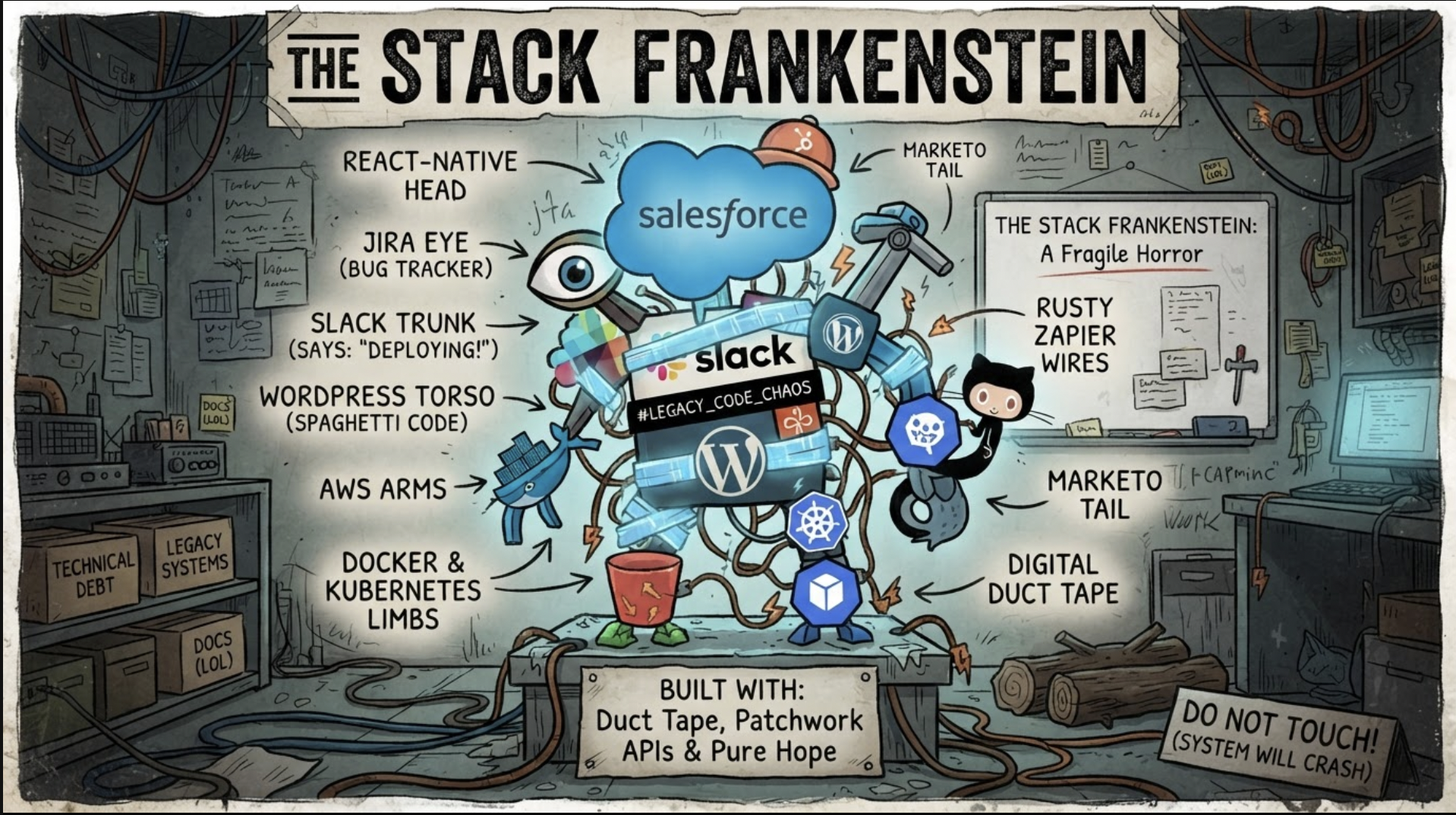
Imagery Concept: "Before vs. After Blueprint"
A side-by-side infographic. Left: A chaotic, tangled web of 40 overlapping tools labelled "Unplanned Stack." Right: A streamlined, color-coded 5-layer workflow labelled "Architected Stack."
Ready to Audit Your Stack? Get the Plug-and-Play MarTech Bundle
Auditing an entire software ecosystem on a blank spreadsheet is a quick way to lose two full weeks of work to formatting formulas and chasing down rogue credit card charges. Why reinvent the wheel when you can run a enterprise-grade stack audit today?
Our Ultimate MarTech Audit & Architecture Toolkit gives you the exact step-by-step framework, automated spreadsheets, and visual blueprints used by top RevOps leaders to eliminate SaaS waste and streamline data flow.
What’s Included in Your Digital Download:
- Stack Inventory: one row per tool with cost, owner, renewal date, and seat tracking. Utilization calculates automatically and flags anything under 50%.
- Capability Map: mark which tools cover which capabilities and instantly see where you're paying twice, or covering nothing at all.
- Weighted Scoring: rate each tool on adoption, business value, data quality, integration health, and cost efficiency. Adjustable weights generate an automatic Keep, Optimize, Consolidate, or Retire recommendation.
- Findings Dashboard: total spend, at-risk spend, redundancy count, and capability gaps, calculated for you and formatted to share with leadership.
- Prioritized Roadmap: turn findings into an action plan with dollar impact, owners, and dates.
Stop paying the sprawl tax. Download the Ultimate MarTech Audit Stack Checklist right now, reclaim thousands in wasted software budget, and build a lean marketing machine that actually scales.
Need More Help? Download The CDP Evaluation Scorecard and get help scoring your CDP.